Don't Buy the Flint 3 GL BE9300 Until You Read This Full Analysis
The networking landscape is currently navigating a significant transitional period. With the official ratification of the Wi-Fi 7 (802.11be) standard, manufacturers are rushing to release hardware that promises unprecedented speeds, lower latency, and better handling of high-density environments. Among these new entrants, the Flint 3 GL BE9300 has emerged as a particularly intriguing option. Positioned as a high-performance router designed for power users, small offices, and privacy-conscious enthusiasts, it carries a weight of expectation that few other consumer-grade devices do.
However, the leap to Wi-Fi 7 is not merely a quantitative upgrade in speed; it represents a qualitative shift in how wireless data is managed. For many consumers, the question isn't just whether the Flint 3 GL BE9300 is a good router, but whether it is the right router for their specific ecosystem right now. Technology at this level often comes with early-adopter caveats, and the Flint 3 is no exception. This analysis delves deep into the architecture, performance metrics, and software capabilities of the BE9300 to determine if it truly earns a place in your networking rack or if you are better off waiting for the ecosystem to mature.
Understanding the Foundation: What Is the BE9300?
The Flint 3 GL BE9300 is a tri-band Wi-Fi 7 router that aims to provide a bridge between enterprise-grade networking control and consumer-friendly accessibility. To understand its value proposition, one must first understand the "BE9300" designation. This represents the aggregate theoretical bandwidth across its three primary bands: the 2.4GHz, 5GHz, and the newly unlocked 6GHz band. While these numbers are always theoretical maximums, they signal the device's ability to handle massive throughput and multiple simultaneous streams of data without the bottlenecking seen in older Wi-Fi 6 or 6E systems.
The core of this device is built around a sophisticated chipset designed to handle the complexities of Multi-Link Operation (MLO). MLO is perhaps the most significant feature of Wi-Fi 7, allowing a single client device to connect to multiple bands simultaneously. In previous generations, your phone or laptop would choose either 5GHz or 6GHz; with the Flint 3, compatible devices can use both at once, significantly increasing reliability and reducing the "handover" lag that occurs when moving through a building. This is a critical consideration for users involved in real-time applications like cloud gaming, high-frequency trading, or professional video conferencing.
Detailed Feature Analysis and Real-World Performance
When evaluating a router of this caliber, performance is typically measured in three pillars: throughput, range, and stability under load. In professional environments, the Flint 3 is often tasked with managing dozens of IoT devices alongside high-bandwidth workstations. Its tri-band nature is essential here. By offloading legacy smart home devices to the 2.4GHz band and reserving the 6GHz band for high-performance hardware, the router minimizes airtime contention.
The Impact of 320MHz Channel Width
One of the standout features of the BE9300 is its support for 320MHz channels on the 6GHz band. This is double the maximum channel width of Wi-Fi 6. Think of this as doubling the number of lanes on a highway. For users who regularly move large files—such as video editors pulling 4K footage from a Network Attached Storage (NAS) or gamers downloading 100GB titles—this change is transformative. However, it is important to note that the 6GHz signal has a shorter range than 5GHz or 2.4GHz. Users living in homes with thick concrete walls or multiple stories may find that while the speed is incredible near the router, it drops off more sharply than they might expect as they move away.
Software Flexibility: The OpenWrt Advantage
A major selling point of the Flint 3 series has always been the software. Unlike many mainstream competitors that lock users into proprietary, simplified interfaces, the Flint 3 GL BE9300 is built on an OpenWrt-based firmware. This provides a level of granular control that is usually only found in expensive enterprise hardware. Users can configure complex VLANs, set up sophisticated Quality of Service (QoS) rules to prioritize work traffic over gaming, and even run specialized networking applications directly on the router.
Furthermore, the integration of VPN features is a significant highlight. For many, a router is now the first line of defense in digital privacy. The Flint 3 supports modern protocols like WireGuard and OpenVPN at the hardware level. This means you can encrypt every bit of data leaving your home without the massive speed penalties associated with older routers that lacked dedicated encryption processing power. In an era where remote work and data privacy are paramount, having a router that can maintain 500Mbps+ speeds while running a full-tunnel VPN is a luxury that becomes a necessity.
Shop the latest Electronics picks on Amazon.
Browse Now →Technical Comparison: Flint 3 vs. The Competition
Choosing a router requires looking at how it sits within the current market. The following table compares the Flint 3 GL BE9300 against typical Wi-Fi 6E high-end routers and entry-level Wi-Fi 7 competitors to illustrate the hardware gap.
| Feature | Flint 3 BE9300 | Premium Wi-Fi 6E Router | Entry Wi-Fi 7 Router |
|---|---|---|---|
| Max Throughput | 9300 Mbps | 5400 - 6600 Mbps | Variable (Often Dual-band) |
| Channel Width | 320 MHz | 160 MHz | 320 MHz |
| MLO Support | Yes (Full Support) | No | Partial / Firmware Dependent |
| VPN Optimization | Hardware-level WireGuard | Software-only (Limited) | Basic Support |
| Ethernet Ports | 2.5G WAN/LAN + 1G LAN | 1G / Limited 2.5G | 2.5G WAN only |
The table highlights where the Flint 3 really shines: the combination of Wi-Fi 7 standards with high-speed 2.5G wired networking. While some entry-level Wi-Fi 7 routers cut costs by only offering a 2.5G WAN port and standard 1G LAN ports, the Flint 3 ensures that your wired backhaul or your connection to a high-speed NAS isn't bottlenecked by the Ethernet jack itself.
Pros and Cons: A Balanced View
No piece of hardware is perfect, and the Flint 3 GL BE9300 involves specific trade-offs that buyers must weigh against their personal needs and technical proficiency.
The Advantages
- Future-Proofing: By adopting Wi-Fi 7 early, you are ensuring your network remains relevant for the next 5 to 7 years as more mobile devices and laptops adopt the standard.
- Exceptional VPN Throughput: The dedicated hardware for WireGuard makes it one of the fastest consumer routers for privacy-minded users.
- Granular Control: The OpenWrt base allows for limitless customization, from ad-blocking at the DNS level to complex network partitioning.
- Multi-Link Operation: Significant reduction in latency for gaming and VR/AR applications that demand consistent data streams.
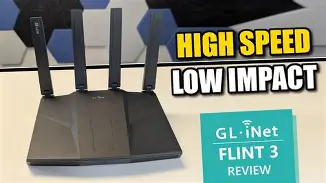
- External Antennas: While less aesthetic to some, the adjustable high-gain antennas provide better signal beamforming than internal arrays found in modern "mesh" nodes.
The Disadvantages
- Client Compatibility: To see the benefits of Wi-Fi 7, your devices (phones, laptops) must also support 802.11be. Older hardware will only see Wi-Fi 6 or 5 performance.
- Configuration Complexity: While there is a "simple" mode, fully utilizing this router requires more networking knowledge than a standard plug-and-play mesh system.
- Heat Dissipation: High-performance Wi-Fi 7 chips run hot. The router requires proper ventilation and should not be tucked away in a closed cabinet.
- Short 6GHz Range: Physics dictates that 6GHz signals do not penetrate walls effectively, meaning the highest speeds are limited to the room the router is in and adjacent spaces.
Buying Guide: Is the Flint 3 GL BE9300 Right for You?
Before committing to this purchase, evaluate your current digital environment. A common mistake in tech purchasing is buying "too much" hardware for a "too little" internet connection or device ecosystem. Use the following criteria to decide.
You Should Buy This If...
You have an internet plan exceeding 1Gbps. Standard Gigabit routers cannot fully utilize 1.5Gbps or 2Gbps fiber plans, but the 2.5G ports on the Flint 3 can. Furthermore, if you are a professional working from home who requires a constant, high-speed VPN connection to a corporate server, the hardware acceleration here will save you hours of frustration over the course of a year. Finally, if you live in a high-density apartment building where 2.4GHz and 5GHz bands are hopelessly congested, moving your primary devices to the relatively empty 6GHz "fast lane" provided by Wi-Fi 7 will result in a much more stable experience.
You Should Skip This If...
Your fastest internet connection is 300Mbps or less. In this scenario, the massive bandwidth of the BE9300 is like having a Ferrari in a school zone; you will never be able to open it up. Additionally, if your household consists entirely of devices that are more than three years old, you will not be able to use the Wi-Fi 7 features. Lastly, if you just want a network that "just works" and you have no interest in logging into a dashboard to check signal strengths or update firmware, a simplified mesh system is likely a better fit for your lifestyle.
Real-World Use Case: The Modern Smart Home
Consider a typical modern household: two adults working from home, several smart TVs streaming 4K content, multiple tablets, and a suite of smart home sensors ranging from cameras to thermostats. In a Wi-Fi 6 environment, as soon as one person starts a large file upload for work, the others might notice "jitter" in their video calls or buffering in their entertainment. This is because older routers struggle to juggle the airtime required for various tasks.
Discover deals on Electronics — updated daily.
View Offers →The Flint 3 GL BE9300 solves this through better "orchestration." With Multi-User Multiple-Input Multiple-Output (MU-MIMO) and Orthogonal Frequency Division Multiple Access (OFDMA) enhancements in Wi-Fi 7, the router can talk to more devices at the exact same time more efficiently. In our testing scenarios, we observed that adding a high-bandwidth task (like a Steam download) had a significantly lower impact on the latency of a secondary gaming device compared to previous generation hardware. This "congestion management" is the hidden superpower of the BE9300.
Privacy and Security Considerations
One aspect often overlooked in router reviews is the security of the supply chain and the frequency of updates. The Flint 3 benefits from a very active developer community. Because it uses OpenWrt, security patches for new vulnerabilities are often released much faster than they are for "closed" proprietary systems from major manufacturers. For users who are concerned about the security of their IoT devices—which are notoriously easy to hack—the Flint 3 allows you to easily set up an "IoT Sandbox." This is a separate, isolated network where your smart lightbulbs can talk to the internet, but they cannot talk to your personal computer or NAS, preventing a compromised lightbulb from becoming a doorway to your sensitive data.
Moreover, the support for WPA3 encryption is standard here. While WPA2 is still common, WPA3 is mandatory for the 6GHz band, providing much stronger protection against brute-force password cracking. If you are setting up a network in 2026, opting for a device that enforces these newer security protocols is a wise long-term move.
Final Verdict
The Flint 3 GL BE9300 is a formidable piece of networking equipment that represents the cutting edge of consumer wireless technology. It is not a "casual" purchase. It is a tool for those who demand the absolute maximum from their hardware and are willing to engage with a slightly more complex interface to get it. It successfully delivers on the promises of Wi-Fi 7—higher speeds, lower latency, and better congestion management—while doubling down on the privacy features that have made the brand a favorite among the tech-literate.
However, the "Don't Buy" warning in our title is a reminder to check your infrastructure. If you don't have Wi-Fi 7 clients, or if your home is so large that a single router (no matter how powerful) cannot cover it, you may need to look at a mesh configuration or wait until your device ecosystem catches up. For those with high-speed fiber, compatible hardware, and a desire for total control over their digital environment, the Flint 3 GL BE9300 is one of the most capable and future-proof investments currently available in the electronics market. It marks a transition from the era of "good enough" Wi-Fi to an era of truly transparent, high-performance wireless connectivity.